Someone hands you a glass of tea. You say eyvallah. A friend confirms tomorrow’s meeting time. Eyvallah again. Later, as you get up to leave, the same word comes with a small wave. Three moments, three English translations, and nobody speaking Turkish has noticed anything unusual.
Everyday conversation is full of these small, adaptable expressions. They thank people, hurry them along, soften an awkward answer or put an end to a discussion. Sometimes the change comes from a raised eyebrow; sometimes from the words around them. A few are whole phrases rather than single words, and their translations are best understood as responses to a situation.
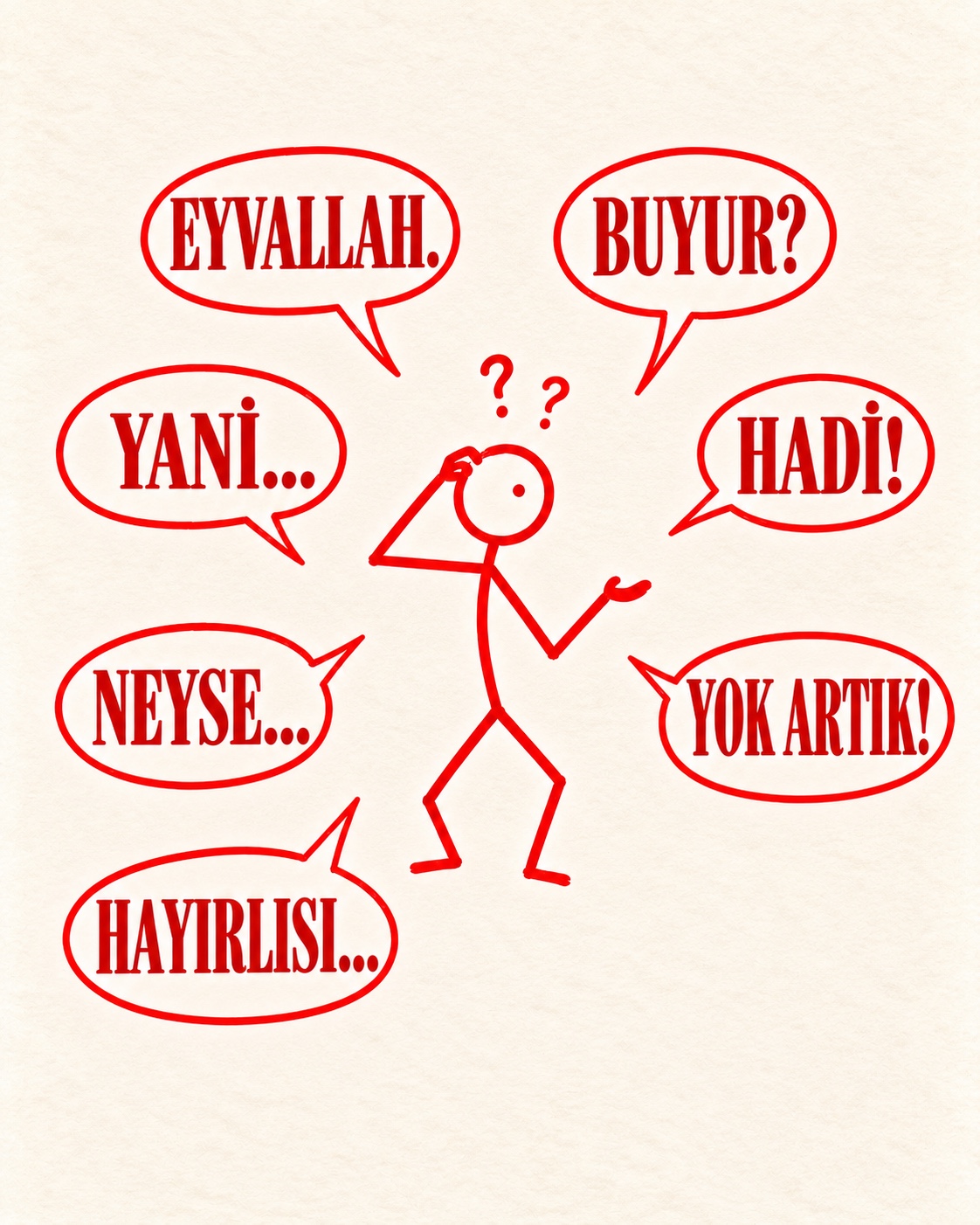
Here are eight worth listening for, from an invitation to sit down to the rather less polite thing you might say when you realise you have missed the last train.
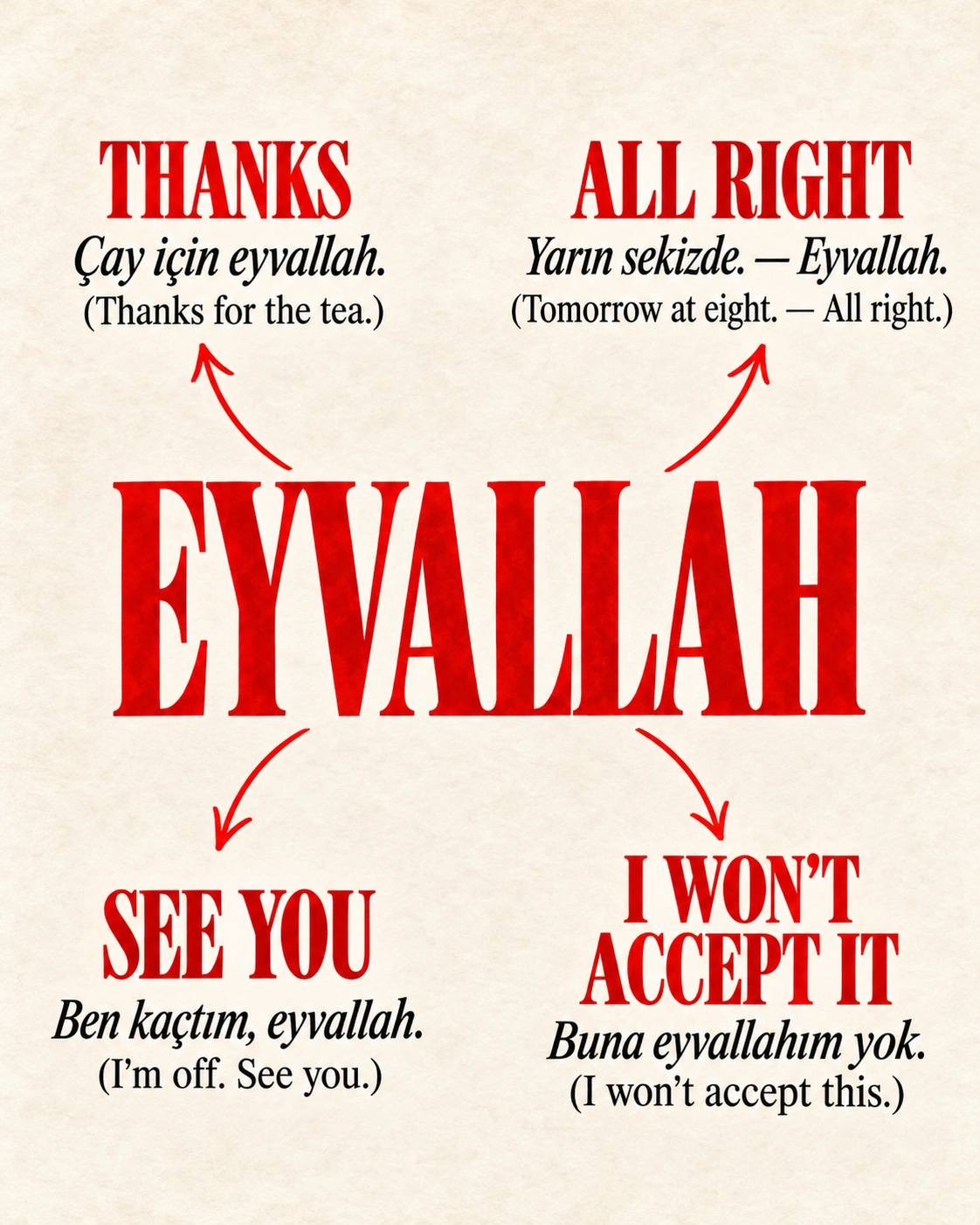
1. Eyvallah
Eyvallah has the easy familiarity of a nod across a table. It can acknowledge a kindness, settle an arrangement or accompany a casual goodbye. It often sounds warmer and less formal than a carefully delivered thank-you, though its tone depends on the relationship between the speakers. Put it inside buna eyvallahım yok, however, and the acceptance disappears: you are saying that this is something you will not put up with.
- Thanks: Çay için eyvallah. (Thanks for the tea.)An informal acknowledgement of a small kindness.
- All right: Yarın sekizde. — Eyvallah. (Tomorrow at eight. — All right.)The plan has been understood and accepted.
- See you: Ben kaçtım, eyvallah. (I’m off. See you.)A relaxed goodbye among people who know one another.
- I won’t accept it: Buna eyvallahım yok. (I won’t accept this.)In this negative expression, the word becomes a refusal to tolerate something.
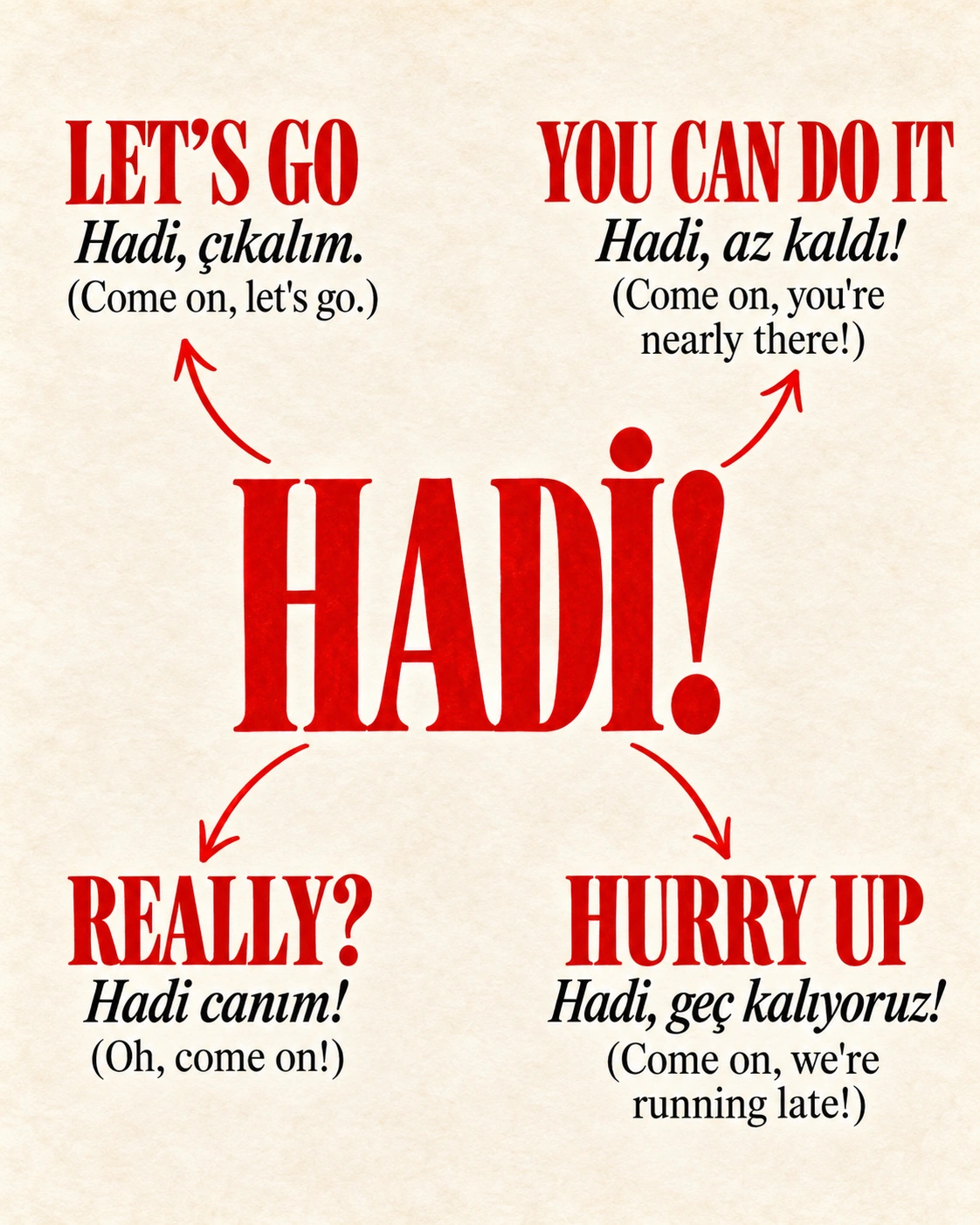
2. Hadi
Hadi is often the sound of a conversation trying to get somewhere. It gets people out of the house, encourages someone through a difficult final stretch and reminds the friend still looking for their keys that everyone else is waiting. Add canım and it can become an amused or sceptical response to a story. The difference between encouragement and irritation may be no more than how sharply it lands.
- Let’s go: Hadi, çıkalım. (Come on, let’s go.)An invitation to get moving.
- You can do it: Hadi, az kaldı! (Come on, you’re nearly there!)Encouragement when someone needs one more push.
- Really?: Hadi canım! (Oh, come on!)Surprise or disbelief; the tone can be playful rather than dismissive.
- Hurry up: Hadi, geç kalıyoruz! (Come on, we’re running late!)The same invitation, with considerably less patience.
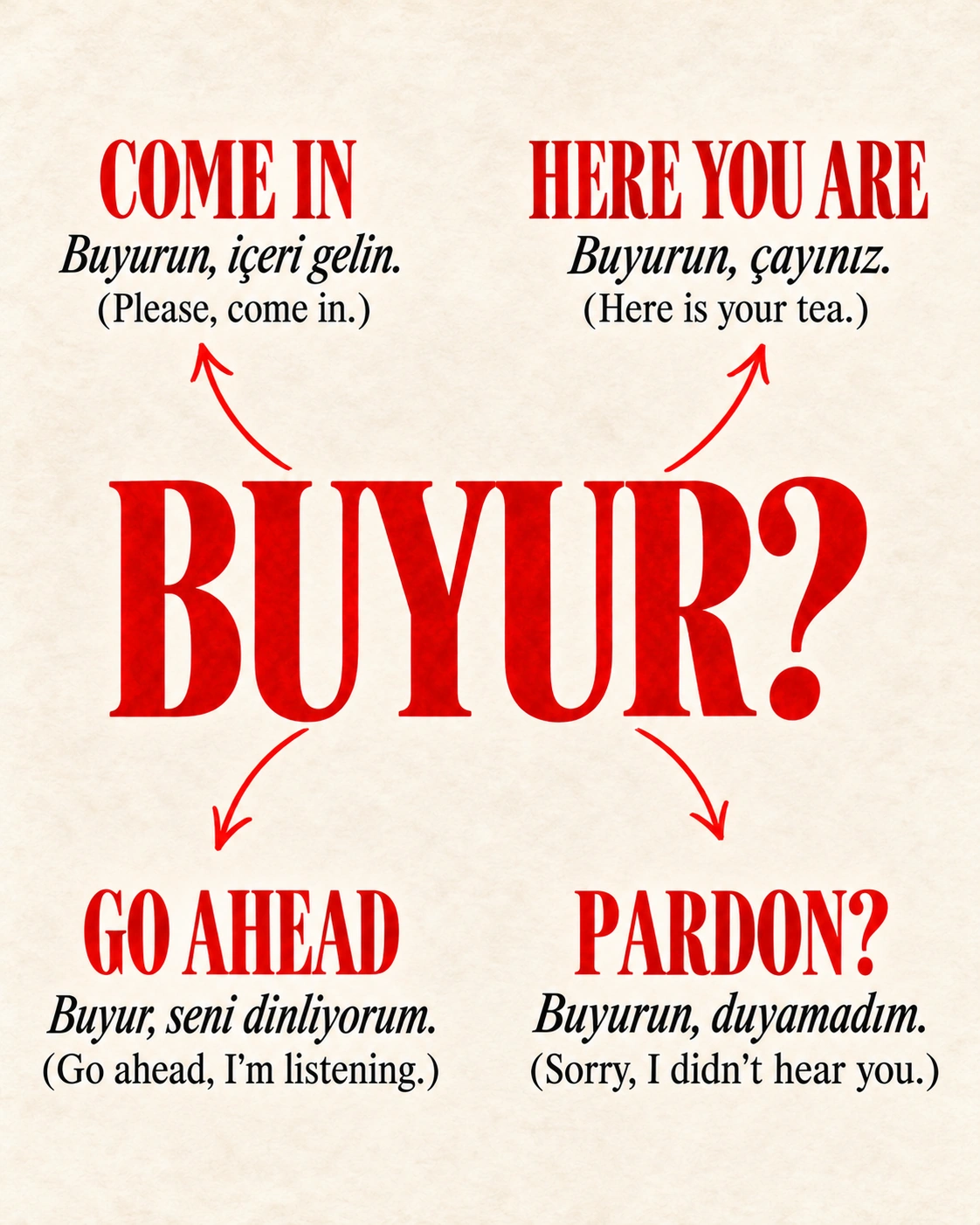
3. Buyur
At a doorway, buyur makes room for you. At a table, it accompanies something being offered. In a conversation, it hands you the floor. You will often hear buyurun, the polite or plural form, from a host, a waiter or someone answering a request. A questioning buyur can also ask for a sentence to be repeated. Say it more sharply and the question becomes a challenge: did you really just say that?
- Come in: Buyurun, içeri gelin. (Please, come in.)An invitation from someone welcoming you inside.
- Here you are: Buyurun, çayınız. (Here is your tea.)Said while handing or serving something to someone.
- Go ahead: Buyur, seni dinliyorum. (Go ahead, I’m listening.)An invitation to speak.
- Pardon?: Buyurun, duyamadım. (Sorry, I didn’t hear you.)A polite request to repeat something.
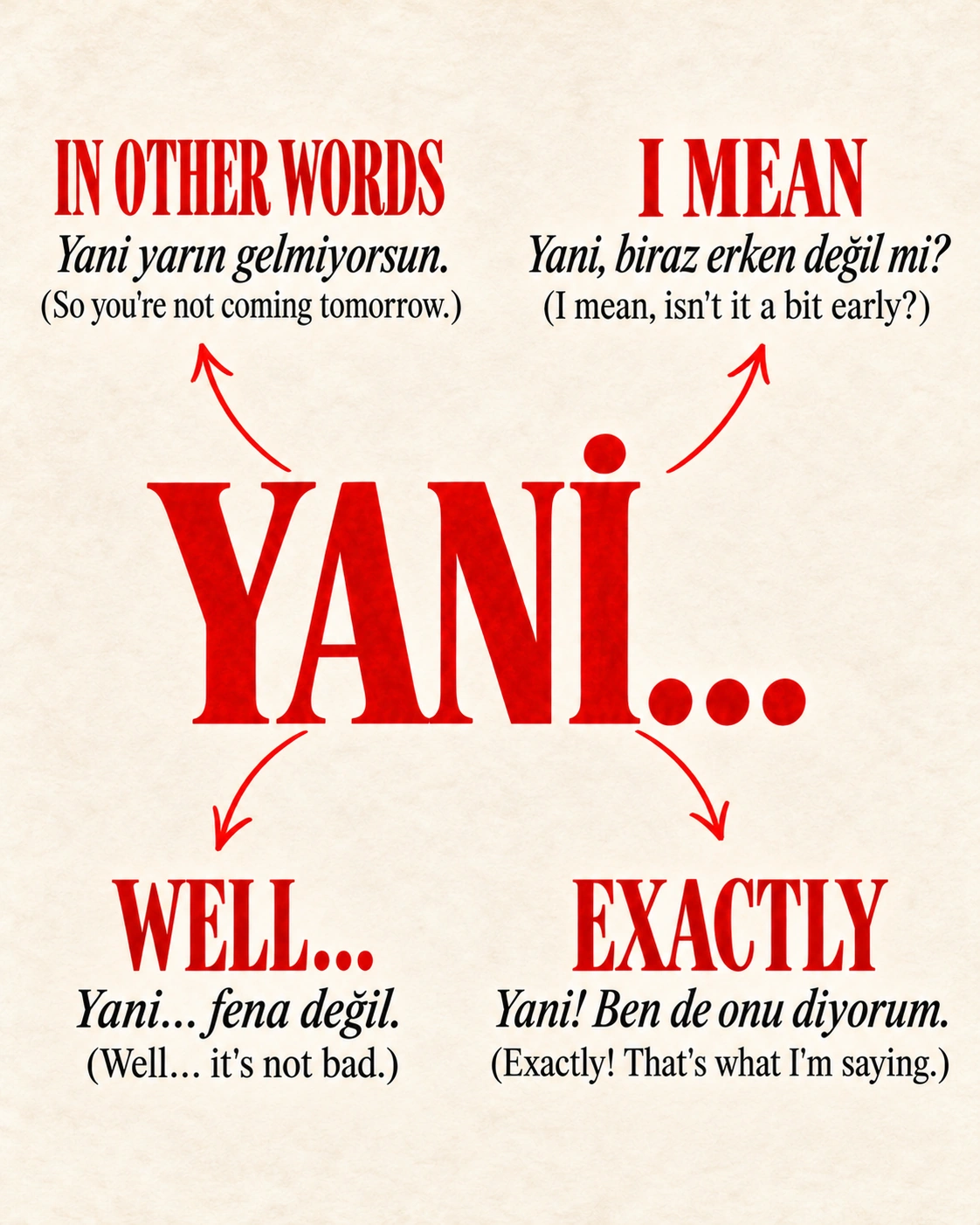
4. Yani
Yani helps a speaker work out what they actually want to say. It can introduce an explanation, draw a conclusion or buy a moment before an answer. Ask someone whether they liked a film and a lingering yani may tell you that the praise will be limited. In an emphatic reply, though, it can signal recognition: yes, that is precisely the point I have been trying to make.
- In other words: Yani yarın gelmiyorsun. (So you’re not coming tomorrow.)Drawing a conclusion from what has just been said.
- I mean: Yani, biraz erken değil mi? (I mean, isn’t it a bit early?)Introducing a qualification or a mild objection.
- Well…: Yani… fena değil. (Well… it’s not bad.)The pause makes room for hesitation.
- Exactly: Yani! Ben de onu diyorum. (Exactly! That’s what I’m saying.)An emphatic, conversational agreement.
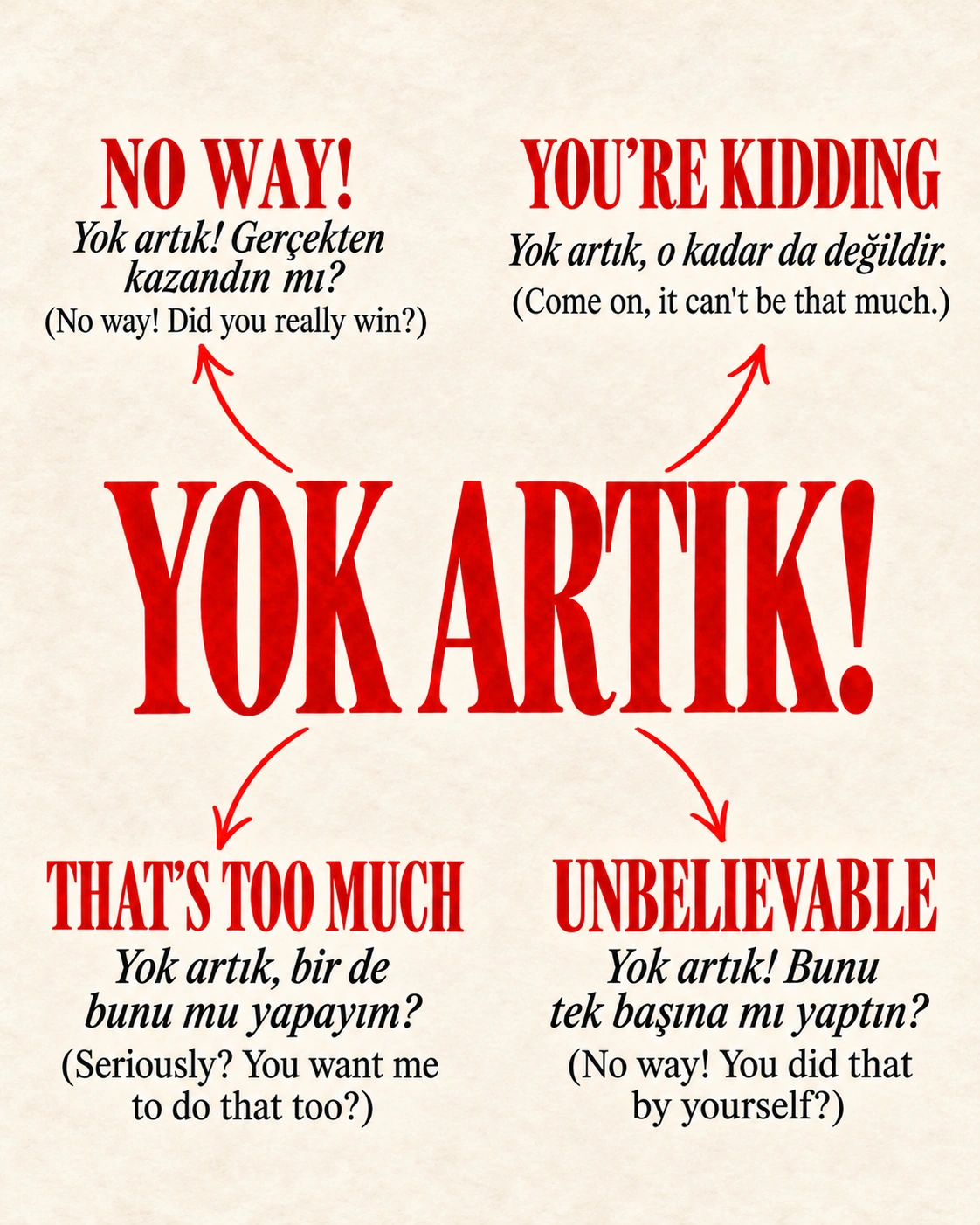
5. Yok artık
Read word by word, yok artık does little to prepare you for its life in conversation. It is a reaction to something that seems difficult to believe: an unexpected win, an extravagant price, an unreasonable demand or a genuinely impressive achievement. It can be delighted, annoyed or openly sceptical. Listen to the next sentence before deciding whether the speaker is congratulating you or refusing to believe a word.
- No way!: Yok artık! Gerçekten kazandın mı? (No way! Did you really win?)Surprise at unexpected news.
- You’re kidding: Yok artık, o kadar da değildir. (Come on, it can’t be that much.)Disbelief at a figure or an exaggerated claim.
- That’s too much: Yok artık, bir de bunu mu yapayım? (Seriously? You want me to do that too?)A protest when a request goes too far.
- Unbelievable: Yok artık! Bunu tek başına mı yaptın? (No way! You did that by yourself?)Astonishment that can carry real admiration.
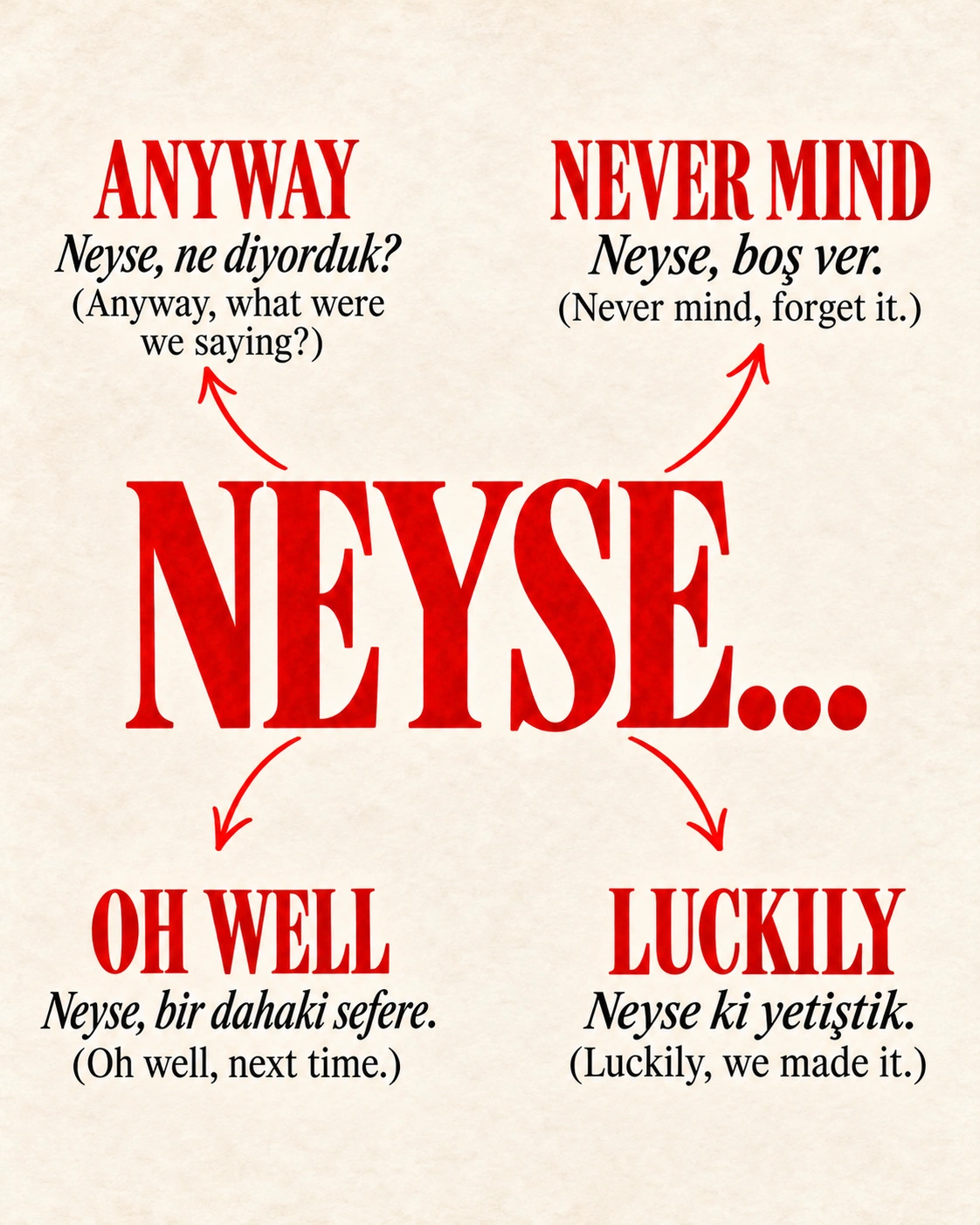
6. Neyse
Neyse lets a conversation move on, whether or not everyone feels finished with it. It can bring a wandering story back to the point, dismiss a small problem or help someone accept a disappointment. A brisk neyse may close the subject more firmly than a long explanation would. Add ki and the expression changes direction: neyse ki means fortunately or luckily, introducing the thing that went right.
- Anyway: Neyse, ne diyorduk? (Anyway, what were we saying?)Returning to the conversation after a distraction.
- Never mind: Neyse, boş ver. (Never mind, forget it.)Letting something go, gently or impatiently.
- Oh well: Neyse, bir dahaki sefere. (Oh well, next time.)Accepting a disappointment and looking ahead.
- Luckily: Neyse ki yetiştik. (Luckily, we made it.)This meaning belongs to the complete expression neyse ki.
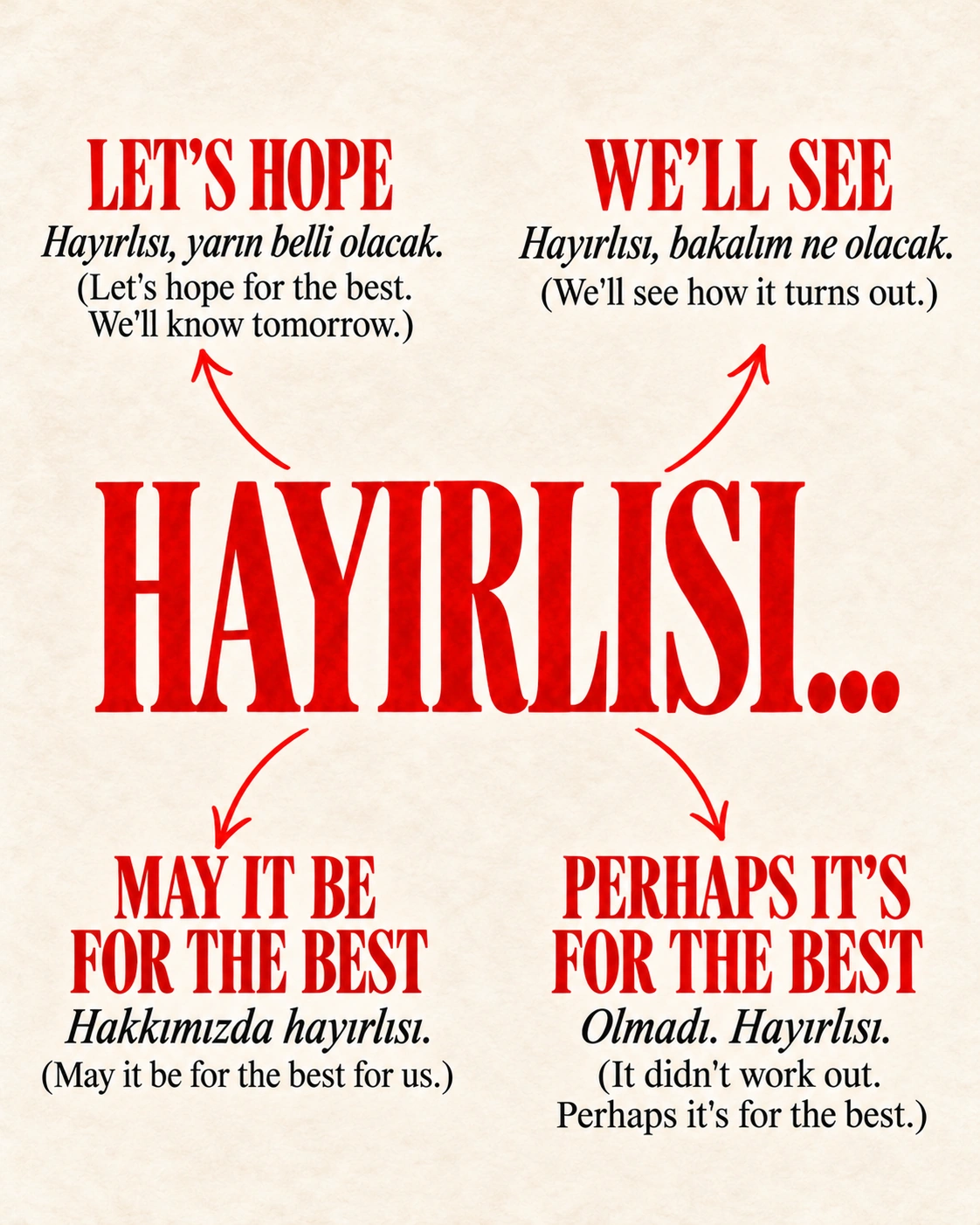
7. Hayırlısı
Hayırlısı expresses a wish for a good outcome, especially when that outcome is no longer entirely in your hands. Before a decision, it can sound hopeful; while waiting, more accepting; after a disappointment, it may offer consolation. These are shades of the same wish rather than four separate dictionary meanings. A person saying hayırlısı may still care very much about the answer. They are simply leaving room for what happens next.
- Let’s hope: Hayırlısı, yarın belli olacak. (Let’s hope for the best. We’ll know tomorrow.)Hope before an uncertain result.
- We’ll see: Hayırlısı, bakalım ne olacak. (We’ll see how it turns out.)Accepting that the outcome is still open.
- May it be for the best: Hakkımızda hayırlısı. (May it be for the best for us.)A wish for the outcome that will ultimately be good for those involved.
- Perhaps it’s for the best: Olmadı. Hayırlısı. (It didn’t work out. Perhaps it’s for the best.)A way of making peace with disappointment.
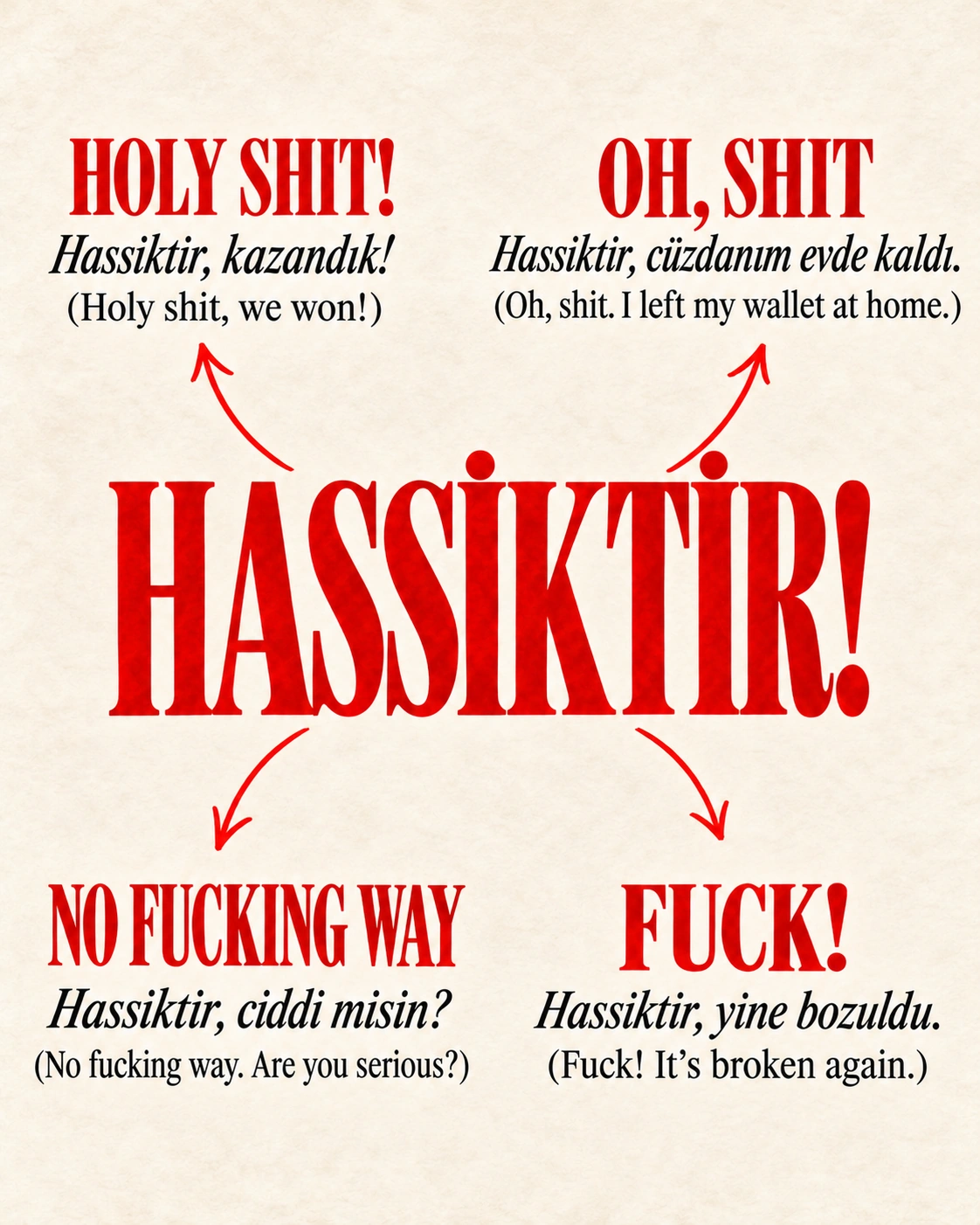
8. Hassiktir!
And then there is the reaction that arrives before you have had time to choose your words. Hassiktir can burst out at extraordinary news, a sudden realisation or something going wrong yet again. It is strongly vulgar: the English equivalents below convey its force in these situations, rather than a literal translation. Among close friends it may express shared astonishment; directed at a person, it can be hostile. It is not a neutral substitute for “really?” or a polite expression to try on a stranger.
- Holy shit!: Hassiktir, kazandık! (Holy shit, we won!)A sudden burst of delighted disbelief.
- Oh, shit: Hassiktir, cüzdanım evde kaldı. (Oh, shit. I left my wallet at home.)The instant an unwelcome realisation hits.
- No fucking way: Hassiktir, ciddi misin? (No fucking way. Are you serious?)An emphatic reaction to something hard to believe.
- Fuck!: Hassiktir, yine bozuldu. (Fuck! It’s broken again.)Frustration when a problem returns.
The next time one of these expressions comes up, notice what happens around it: the offered glass, the pause before an answer, the smile, the sigh. Those details are part of what you are being told. A translation gets you started; the conversation does the rest.