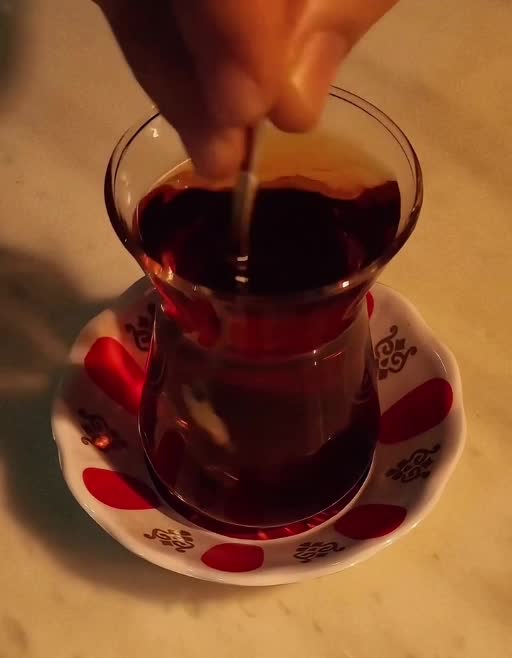
Before the first sip, a Turkish tea glass has already told you something about the drink. Hold it towards the light and the colour becomes legible: a pale amber, a deeper red, a brew that might welcome a little more water. Transparency is doing useful work. So is the small scale of the vessel, which makes a refill an ordinary part of drinking.
The familiar form has a full lower bowl, a narrow waist and an opening that widens again towards the lip. In Turkish it is called ince belli: slender-waisted. There is no handle and no raised stem. The outline is recognisable even when the glass is empty, stripped of the tea that usually gives it colour.
It is an apt place to begin The Design Issue. Here is an object whose cultural authority has been established through use, with no widely recognised designer attached to it. Understanding how it became so familiar takes us from the late Ottoman household to the glass factory, and from tea-growing policy to the small decisions made each time a glass is poured.
An outline before an origin story
The origins of the ince belli cannot be reduced to a securely documented inventor and date. Oya Filiz Sağıroğlu’s 2014 research at Istanbul Technical University traces evidence of the form to the last quarter of the nineteenth century. Drawing on historical material and Paşabahçe’s archives, the study examines how its types developed and considers possible early producers and customers. Its conclusions leave room for uncertainty about the first glass. 1
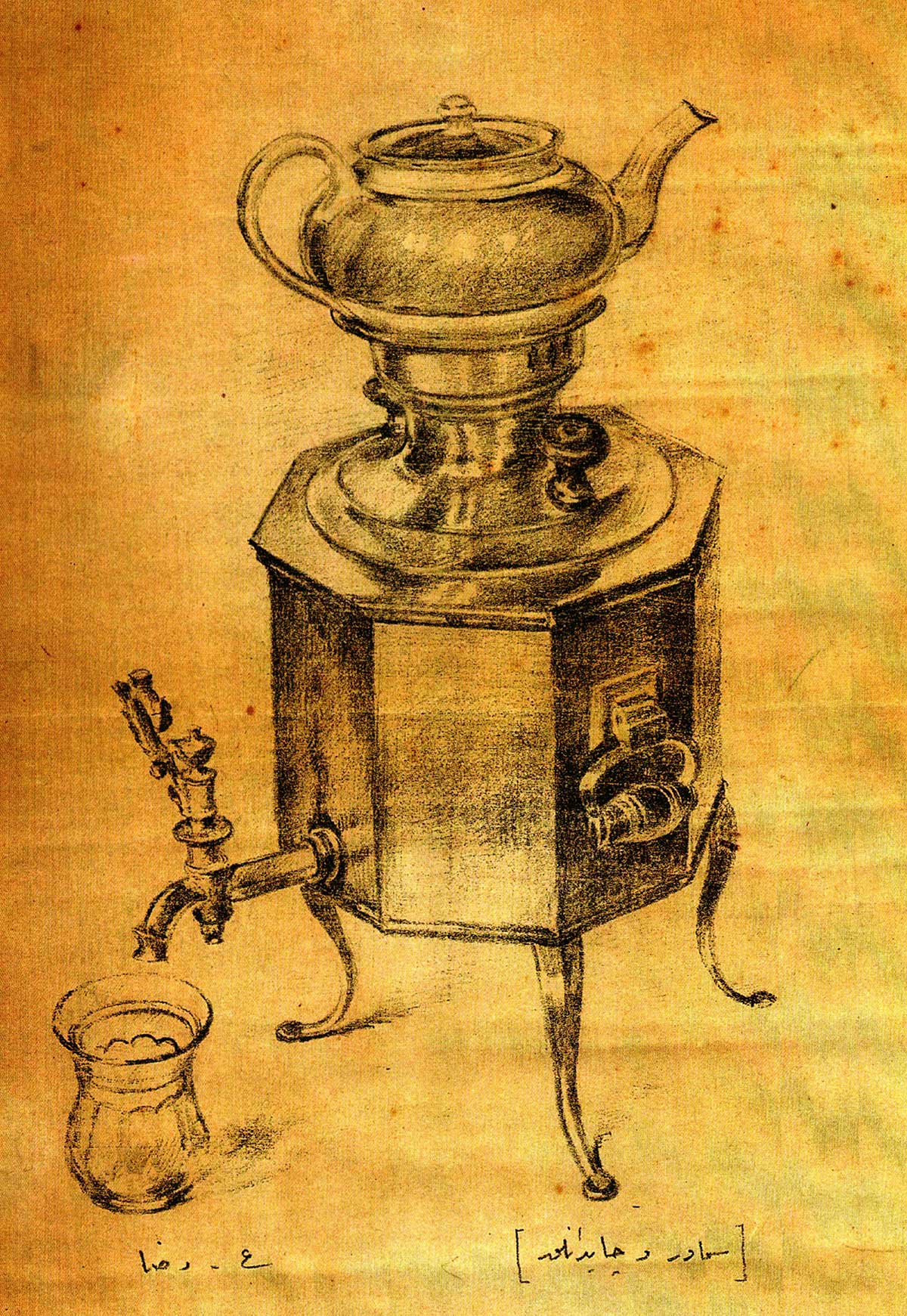
Hoca Ali Rıza’s drawing known as Semaver offers a particularly engaging visual reference. A small waisted glass sits beside the much larger samovar, its curves plainly visible. The work is discussed in research on Turkish tea culture, but calling it the first-ever appearance of the glass goes beyond what that evidence establishes. A drawing records an object that the artist encountered; it does not necessarily record its invention. 2
The resemblance to a tulip has invited more elaborate origin stories, including a supposed commission at the court of Ahmed III. We found no reliable documentation for that commission in the research consulted. The comparison can stand as a description of the shape. It does not supply a history of who made it. The surviving evidence makes the later Ottoman setting a firmer starting point.
A glass that lets you judge the tea
Tea served from a çaydanlık is mixed at the point of pouring: concentrated brew from the upper pot, hot water from below. The proportions can change from glass to glass. Açık asks for a lighter tea; demli for a stronger one. Clear glass makes that adjustment visible. In his study of Turkish tea culture and its objects, design researcher Serkan Güneş identifies this visibility as an important part of the vessel’s appeal. 2
Its shape also gives the hand choices. The waist and the flared rim offer different places to hold it, though neither makes hot glass immune to heat. There is no need to credit the curves with miraculous insulation to appreciate the design. Their effect is immediately apparent in the way a hand approaches the vessel and in the uninterrupted view of the tea inside.

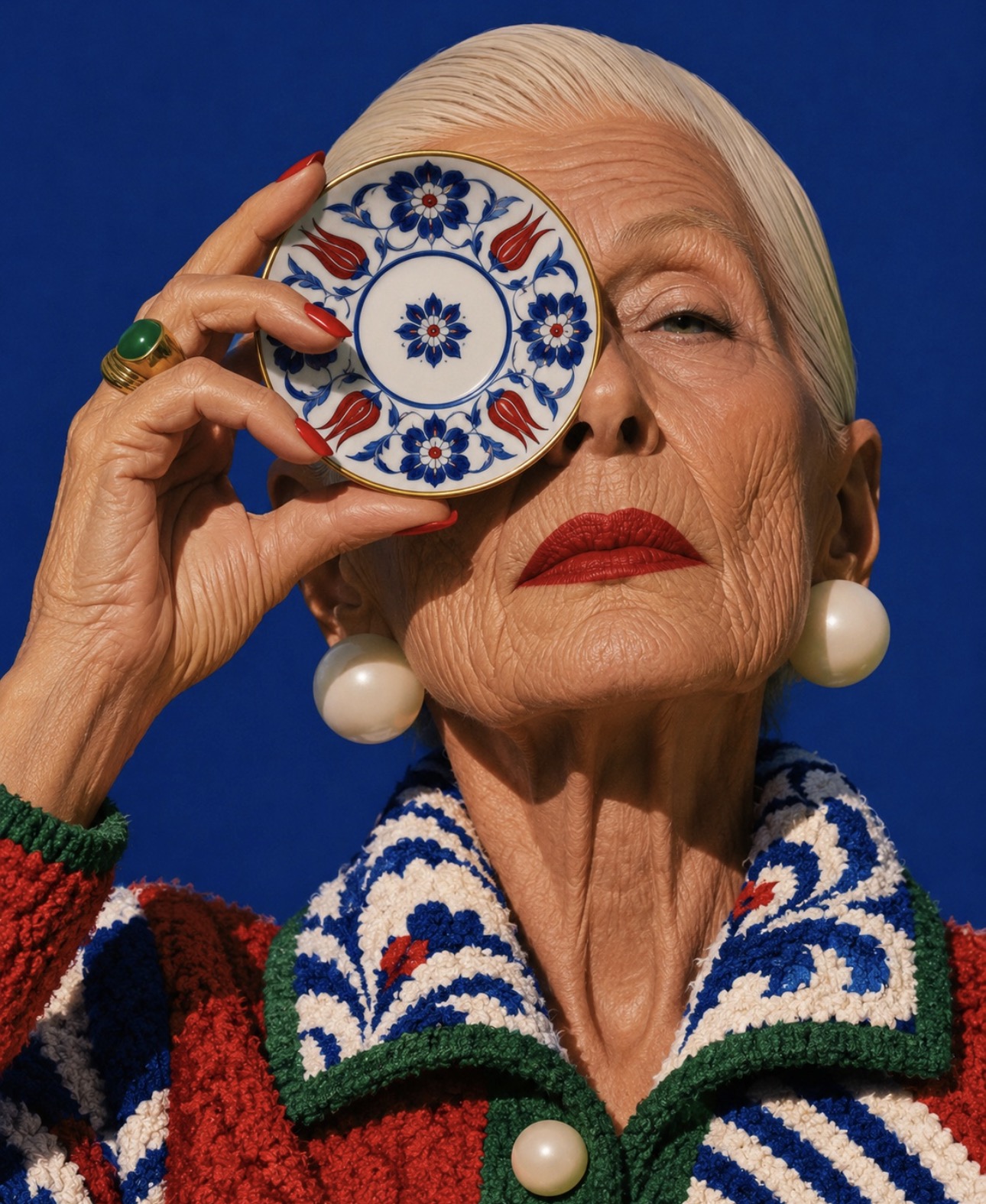
The saucer deserves attention too. It catches a spill, carries the spoon and gives the glass a place to return to. Plain glass allows a painted saucer to supply the decoration. In the accompanying portrait, blue flowers and red tulips surround the tea without obscuring it. The visual richness belongs to the pairing: a transparent vessel above an ornamented surface.
The factory behind the familiar form
An object becomes ubiquitous partly because it can be made again. Paşabahçe’s factory began production in 1935, establishing an important industrial base for Turkish glassware. The company dates the beginning of mechanical production at the factory to 1955 and the opening of its first shop, in Istanbul’s Beyoğlu district, to 1957. These are milestones in the means of making and circulating glass, rather than a birth certificate for the ince belli. 3
For an everyday drinking vessel, availability is a design consideration. A glass that breaks needs replacing; a household needs enough for guests; a business needs many of them. Consistency matters when objects are bought in sets and used repeatedly. The history of a familiar silhouette therefore includes the less conspicuous work of production and distribution, alongside the question of who first drew the curve.
This helps explain why looking only for an individual author feels incomplete. A successful everyday type can be refined, reproduced and recognised across successive versions. Its public identity rests on a family resemblance. People know the glass before they know which factory made the one in their hand.
A country learning to grow its tea
The growth of domestic tea production belongs alongside this industrial history. ÇAYKUR’s institutional account records legislation supporting tea cultivation in the Rize and Borçka area in 1924. The first tea factory opened in Rize in 1947. Imports continued to help meet domestic consumption until 1963, after which Turkish production supplied that demand. Tea’s national prominence was built over decades of agricultural and manufacturing development. 4
The often-repeated explanation that the glass spread in the 1960s because unemployed migrants needed a cheaper alternative to coffee is too narrow to carry this history on its own. Tea’s expansion depended on supply as well as appetite. Growing it, processing it and putting drinking vessels within reach were all part of making an everyday habit possible.
The serving arrangement has a practical advantage of its own. With brewed tea and hot water ready, successive glasses can be prepared to different strengths. Hospitality can happen in small increments. A person can offer one glass without committing to a meal; another can accept it without making a lengthy occasion of the visit.
The refill is part of the experience
In 2022, UNESCO inscribed the culture of çay in Azerbaijan and Türkiye on its Representative List of the Intangible Cultural Heritage of Humanity. The inscription concerns the practices of preparing, serving and sharing tea, and their role in hospitality and social interaction. It recognises a living culture shared across borders, rather than assigning ownership of a single glass shape. 5
The small vessel suits that social rhythm. A large mug can be set down and left alone for a while. A small glass empties sooner, giving someone a reason to pour again. That is an observation about what the design permits, rather than proof of what an unknown maker originally intended. Much of an object’s usefulness is discovered by the people who live with it.
A type that keeps changing
There is no single compulsory size for a Turkish tea glass. Paşabahçe’s contemporary range includes an İnce Belli model of 125 ml and an Aida of 160 ml, among many other forms and capacities. Names, proportions and decoration vary. What looks like one fixed national object is also a continuing field of product decisions. 6
Change the thickness of the base or the width of the opening and the experience changes with it. Add decoration and the balance between seeing the tea and seeing the vessel shifts. A redesign has to negotiate with habits already learned by the hand. Familiarity is a demanding brief: the difference must be worth noticing without making an ordinary action awkward.
That is why the ince belli earns close attention as design. It has a history of manufacture, a recognisable outline and a place in a larger set of objects. It also leaves the person pouring some freedom. A little more brew, a little more water; the result can be judged before the glass reaches the table.
Reading & context
- Archival research on the glass’s origins and the development of Paşabahçe types; proposed beginnings remain scenarios, not an identified inventor
Oya Filiz Sağıroğlu · İnce Belli Çay Bardağı, Istanbul Technical University (2014) - Hoca Ali Rıza’s Semaver and a design analysis of tea culture and its objects
Serkan Güneş · Türk Çay Kültürü ve Ürünleri, Millî Folklor 93 (2012) - The manufacturer’s chronology: production in 1935, mechanical production in 1955 and the first shop in 1957
Paşabahçe · Tarihçe - The development of Turkish tea cultivation, the 1947 factory and domestic supply after 1963
ÇAYKUR · Türkiye’de Çay Tarımının Tarihçesi · ÇAYKUR · Cumhuriyet Dönemi - The joint Azerbaijan–Türkiye inscription of tea culture in 2022
UNESCO · Culture of Çay (tea), a symbol of identity, hospitality and social interaction - Contemporary examples of different glass capacities; catalogue consulted in November 2026
Paşabahçe · Çay Bardakları