There is a particular kind of silence that once belonged to the Turkish coast. It was not emptiness. It was shutters opening before breakfast, fishing boats returning before the heat, glasses being washed in a tea garden, olives falling onto a sheet behind a village house. The coast was never untouched, but it was inhabited before it was consumed.
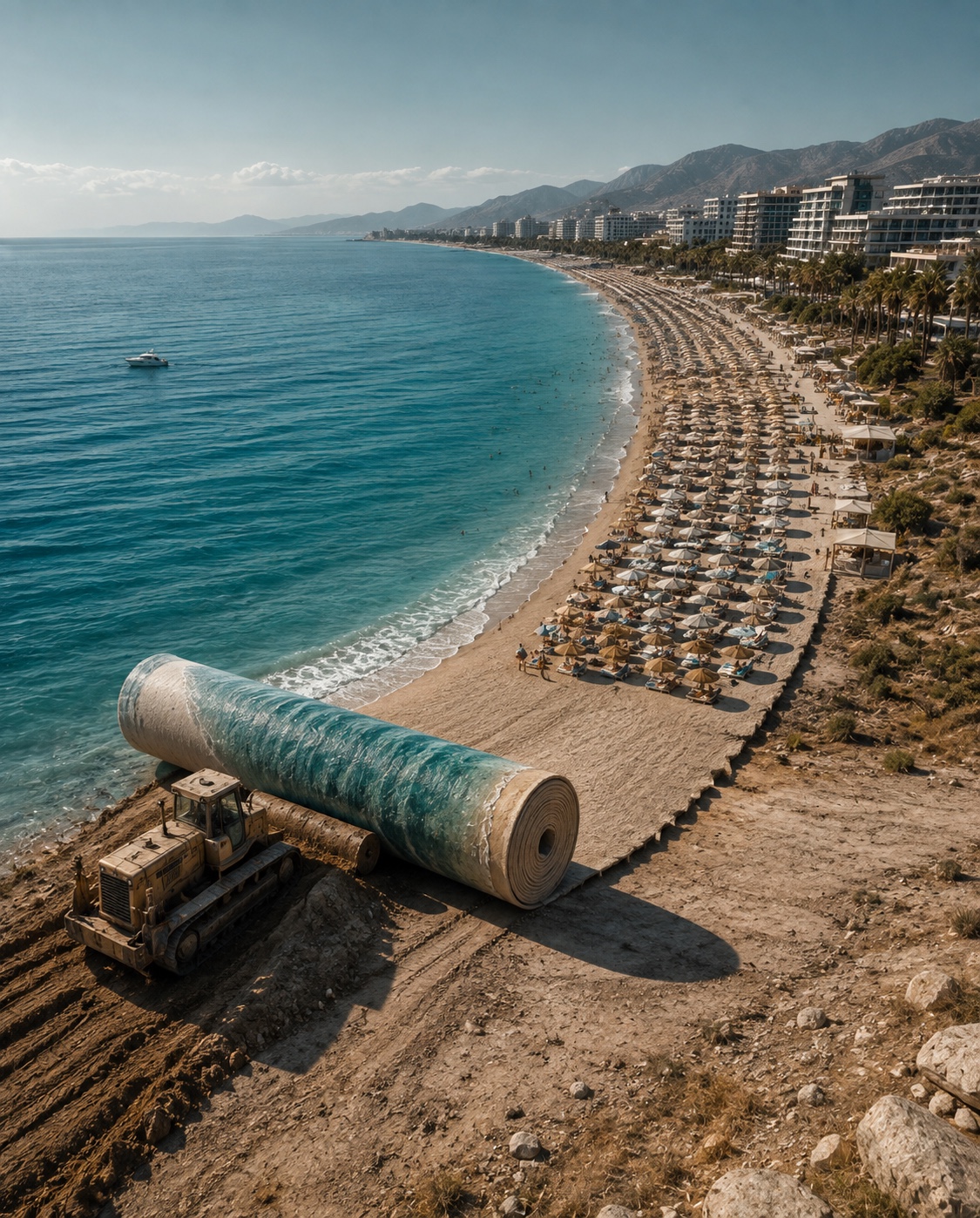
Today the same shoreline is marketed through an increasingly narrow vocabulary: exclusive, private, curated, adults only. From Bodrum to Çeşme, from Alaçatı to Kaş, the landscape is asked to perform one role—to provide an immaculate summer backdrop for people who may never need to know what happens there in February.
A coast can become richer while becoming poorer in everything that made it distinctive.
Success is not the same as health
Türkiye welcomed 64 million international visitors in 2025 and earned a record $65.2 billion from tourism. The OECD estimates that tourism directly generated 5.1 per cent of national gross value added in 2024, accounted for 3.7 per cent of employment and produced almost half of the country’s service exports. Those numbers represent real livelihoods: restaurants, farmers, drivers, pensions, craftspeople and families.
Any argument that simply asks Türkiye to receive fewer visitors ignores this economy and the dignity of the people who depend on it. Tourism has restored buildings that might have collapsed and given younger generations reasons to remain. The problem is not the visitor. It is a development model that counts revenue more carefully than water, public access or permanent life.
The unphotographed city keeps the photographed one alive
Bodrum offers the clearest paradox. Its mythology was built from whitewashed houses, mandarin gardens, blue voyages and studied informality. Its contemporary economy is increasingly organised around marinas, seasonal villas, gated compounds and beach clubs whose visual language could be reproduced in Mykonos, Ibiza or Dubai without changing more than the menu.
In June 2026, Muğla’s water authority completed the replacement of 22 kilometres of Bodrum’s failing main lines, a one-billion-lira intervention designed to reduce leakage, recurring breaks and cuts. Desalination projects are being developed to secure more supply. These are necessary public works. They are also evidence of a race in which infrastructure is repeatedly asked to catch a seasonal city expanding faster than its ecological setting.
Çeşme made the mismatch impossible to ignore in 2025. When the Kutlu Aktaş reservoir fell to five per cent amid drought and heat, compulsory water cuts followed. A swimming pool behind a stone wall looks different when the town beyond it is rationing water.
Preservation can become taxidermy
Alaçatı’s historic houses and wind-shaped streets became desirable because they felt specific. Success then produced imitation: new “old” stone façades, concept restaurants, identical boutiques, identical signs, identical music. The original village became the reference image for a commercial replica of itself.
This is not preservation. It is taxidermy.
Kaş still resists the flattening more convincingly than many coastal towns. Yet Kaş-Kekova is a protected landscape with archaeological remains and more than a thousand recorded marine species. Official conservation work identifies tourism, construction and human pressure among the forces that require an explicit protection-and-use balance. Growth cannot be measured only in new beds, tables, boats and flight seats.
Services can be sold. The sea cannot
Türkiye’s Constitution and Coastal Law treat the shore as a public realm available for common, equal and free use. The lived experience of resort towns increasingly suggests that the best access belongs to whoever can afford a reservation, hotel wristband or minimum spend. A beautifully designed beach club can still sever a neighbourhood from its water.
The question is not whether Türkiye should choose tourism or reject it. Tourism is already part of the coast’s culture and economy. The question is whether the country wants an industry that depends upon the coast—or one capable of caring for it.
A more demanding luxury
Quality tourism should be measured by how much revenue remains locally; whether workers can live near their jobs; whether water and wastewater capacity exists before rooms are approved; whether residents retain access to the shore; whether a town functions beyond twelve profitable weekends; and whether development leaves the next generation more than a collection of expensive addresses.
The most radical coastal luxury may soon be continuity: the same grocer open in January, a public beach without a gate, a hillside that has not become a rendering, a fishing boat that is not there merely as decoration.
Türkiye has not sold its coast in one transaction. It has begun pricing it through thousands of quieter decisions. Those decisions can still change. A coast worth crossing the world to see will be one where visitors can arrive without displacing the life they came to find.