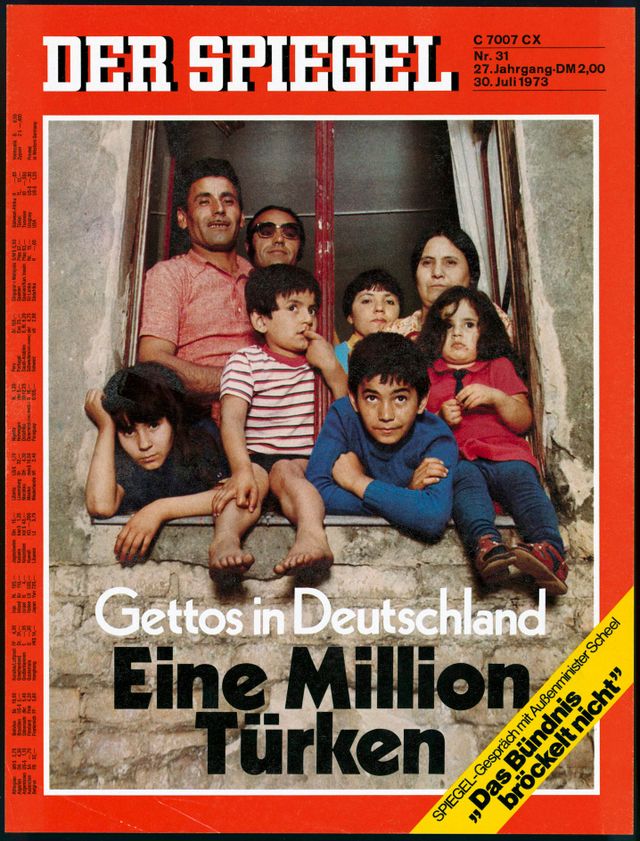
On 30 July 1973, Der Spiegel placed a crowded Kreuzberg window on its cover beneath the words “Ghettos in Germany: One Million Turks.” The number was large. The names were absent. What appeared to be a portrait of migration was published as a category: a population to be counted, discussed and kept at a distance.
A statistic can describe migration. It cannot tell us who kept a city working, who raised children in one and a half rooms, or who returned home.
A room in Kreuzberg
The photograph was made at an old one-and-a-half-room apartment in Kreuzberg. There was no private lavatory; residents used the shared toilet in the building. Two families were together that day. The Dursuns lived there. The Doğans had come to visit. What the cover framed as a “ghetto” was also an ordinary domestic scene: hosts, guests, children leaning into one another and adults making room at the window.
The Dursuns
Ahmet Dursun arrived in Berlin in 1968 and worked as a gardener for the city. In the photograph he is the man in the orange shirt at the front. His wife, İfakat, and their children Arif, Nuray and Cevdet joined him a year later. Their youngest child, Gülay, was born in Berlin in 1970. İfakat stands at the right; Arif wears the blue knit, Cevdet the striped shirt, Nuray is at the far left and Gülay is dressed in red.
İfakat worked at Krone, producing electronic components—one of the millions of workers whose labour helped build post-war Germany while their own housing was treated as temporary. The children finished school and began lives of their own. Arif became a supervisor at Alcatel before starting his own business. Nuray went into care work; Cevdet became a postal worker. In 1984, Ahmet, İfakat and Gülay returned to Türkiye.
The Doğans came to visit
Halis and Zeliha Doğan were another worker family who had arrived in Berlin in the same period. Halis worked at the Mercedes factory. The couple had six children; one later returned to Türkiye, while the others remained in Germany and entered different professions.
According to the family’s account, Halis later died after an incorrect medical treatment. The doctor acknowledged the error and completed the paperwork that allowed the family to pursue the case. It is a painful ending that the cover could never have predicted—and another reminder that a migration story continues long after the camera leaves.
What the caption withheld
Neither family knew that the photograph made outside their home would become a national magazine cover. They posed without knowing that their names, relationships and work would disappear from the published story. The image travelled widely; the people inside it remained anonymous.
They were not “one million Turks.” They were the Dursuns and the Doğans: a municipal gardener, an electronics worker, a factory worker, children who became carers, supervisors and postal workers.
Restoring their names is not a sentimental footnote. It changes what the photograph means. Germany’s migration history is not only an argument about labour agreements, housing and integration. It is also a history of family reunions, shared toilets, Sunday visits, factory shifts, school years, returns and lives built in more than one country. The cover reduced a million people to a headline. The family history gives one doorway its depth back.