The Turkish verb for getting married, evlenmek, begins with ev: home. It is a practical place to begin. A marriage needs somewhere to happen after the guests have left.
In the histories of Turkic communities, establishing that home involved far more people than the couple who would occupy it. Relatives negotiated, property changed hands, food was prepared, singers had work to do. A bride’s departure from one household and arrival in another required an audience. The wedding made a new relationship visible to everyone expected to recognise it.
Those histories cover a vast area and many centuries. Early Turkic societies, the Oghuz world of Dede Korkut, later Central Asian communities and Ottoman Anatolia did not share a single wedding manual. Dynastic chronicles describe rulers; epics give us ideals and anxieties; folklore records customs in particular places. Read together, they reveal a remarkably rich argument about what it takes to begin a family.
A household of one’s own
Oguş, an Old Turkic term associated with family and kinship, belongs to a world in which relatives were a practical resource as well as an emotional attachment. A household needed labour, livestock, possessions and people it could call on. Marriage altered that network. It created new responsibilities and brought other families within reach.
Accounts of early Turkic family life often describe married sons receiving the means to establish a separate household, while the youngest remained with the parents and continued the family hearth. The important distinction is between a separate dwelling and a life detached from relatives. A couple might have its own tent without becoming socially independent of the wider family.
Even the question of whose home a husband entered had different answers. Chinese dynastic histories describe a custom among the Tiele, known in Turkish histories as the Töles, in which a newly married man lived with his wife’s family until the birth of a child. It is a useful detail to keep beside the familiar image of the bride leaving home: residence arrangements were never quite as uniform as a neat summary makes them sound. 1
Before the feast, the negotiations
The intermediary had a demanding job. Known by terms including arkuçı in older Turkic vocabulary, this go-between carried proposals and helped families arrive at an agreement. There were questions of suitability, kinship and resources to settle. Anyone who has watched a wedding budget expand through successive conversations will recognise the usefulness of a tactful third party.
One of the central arrangements was kalın: a transfer of wealth from the groom’s side to the bride or her family. Its form and purpose varied. Animals, goods or money might contribute to the agreement, the wedding or the resources surrounding a new marriage. It should not be confused with the share a son received when setting up his own home. Nor should it simply be renamed çeyiz, the trousseau prepared on the bride’s side. 2
The trousseau gave the coming household a material presence before it existed. Bedding and textiles could be prepared, accumulated and displayed. In later Anatolian practice, the public laying-out of the çeyiz made that work visible. Visitors could see the preparation behind the celebration—and, inevitably, the family’s means.
Marrying beyond one’s immediate kin could also enlarge a family’s circle of support. Exogamy appears prominently in accounts of several Turkic societies, though the rules differed between communities. The epic hero travelling far away to find a bride gives this outward movement an adventurous form. In the Altai epic Maaday-Kara, Kögüdey Mergen’s pursuit of Altın Küskü turns marriage into a succession of trials. An epic tells us what makes a hero worth admiring; it cannot, by itself, tell us how every neighbour married.
The family’s interests—and the bride’s
Family solidarity could be reassuring. It could also make personal choice difficult. Traditions of promising children to one another appear in the wider Turkic world: beşik kuda refers to a betrothal associated with the cradle, while bel kuda describes an agreement made before the children were born. Such arrangements tell us how early adults might begin planning an alliance on the next generation’s behalf.
Remarriage could carry obligations of its own. Levirate, in its narrower meaning, involves a widow marrying a brother of her deceased husband; related arrangements within his family also appear in steppe histories. They could keep dependants, property and political connections within a kin group. Sororate worked in the other direction, with a widower marrying a sister of his deceased wife.
Describing the family’s reasoning does not tell us how much freedom an individual woman possessed. The surviving accounts do not justify a blanket claim that these marriages were always voluntary. Equally, the prominence of some women in political and household life cannot be converted into a universal statement of equal legal rights. Rank, place and period mattered. A history of marriage becomes more interesting when it leaves room for those differences.
The diplomatic record makes the stakes especially clear. The Sui princess Yicheng married successive Eastern Turkic rulers after the deaths of earlier husbands. In a ruling household, a marriage could preserve an alliance across a change of ruler. The wedding arrangement reached well beyond the people who shared a tent. 1
When marriage became foreign policy
Long before those Göktürk marriages, Han China and the Xiongnu used marriage agreements in their diplomacy. Known as heqin, these arrangements linked a woman’s marriage with gifts, negotiations and attempts to manage the frontier. The Xiongnu belong to the earlier history of the steppe; their confederation should not simply be treated as another name for the later Turkic peoples.
One exchange survives with an unusually sharp edge. In 192 BCE, Modu—familiar in Turkish histories as Mete—sent the widowed Empress Dowager Lü a proposal that drew attention to their shared solitude. Her reply pointed to her age, failing strength and lost teeth. She declined while seeking to avoid a confrontation. The episode reads as diplomatic provocation dressed in the language of marriage. It gives us no reason to mistake the proposal for a love letter, or to pretend we can know every calculation behind it.
Centuries later, Bilge Kağan’s inscription recorded marriages between his family and the Türgiş ruling house with an emphasis on the grandeur of the ceremonies. Here, a wedding entered the public record beside the achievements of government. The scale of the occasion said something about the authority of its host. 3
A toy needed feeding
Toy is one of the most useful words in this story. Across Turkic usage it can refer to a feast or a major celebration, including a wedding. The word places the gathering itself at the centre: people brought together, hospitality made public, an occasion large enough to be remembered.
Food was essential to that gathering. Giving a feast announced that a household could host others; a ruler’s feast could display his ability to provide on a much greater scale. Horse races, wrestling and archery added competition to the programme. Skills useful in pastoral and military life also made excellent entertainment when there was an audience.
By the early fifteenth century, the court of Timur could turn a family celebration into an enormous public event. The account of the Castilian envoy Clavijo describes the gathering for Timur’s grandsons in Samarkand: merchants and craftspeople were summoned, stalls and tents were established, and the city’s trades became part of the spectacle. Departure required permission. The hospitality came with a clear reminder of who was in charge.
These royal occasions left unusually detailed records. They should not set the imagined budget for every historical wedding. Their abundance tells us a great deal about courtly display, while the celebrations of ordinary households are harder to reconstruct. Even so, the central task is recognisable: once you have asked people to witness a marriage, you must look after them.
The songs knew about leaving
A wedding could be joyful and still require a lament. In Kyrgyz traditions, the bride’s departure has its own ceremonies and songs, associated with kız uzatuu, the sending-off of the daughter. The music gives form to separation as well as celebration. Some songs advise the bride about the life expected of her; others make space for the sorrow of leaving.
That combination deserves attention. Advice sung in public might carry affection, but it also carried instructions: how to behave, how to join another household, what kind of wife or mother to become. A wedding song can preserve the expectations of the community as clearly as a rule written down.
The Oghuz stories gathered around Dede Korkut likewise place music within the life of the community. Bards, blessings and celebrations accompany marriage. These are stories transmitted and reshaped over generations, with their own literary pleasures; their wedding scenes give us a cultural imagination rather than a verbatim recording of an ancient ceremony.
A distinct, living example is Kazakhstan’s betashar. During this bridal unveiling, a singer introduces and praises the groom’s relatives; the bride greets those named, and the veil is raised. Family members then shower the couple with sweets and coins. The ritual, inscribed on UNESCO’s intangible heritage list in 2024, makes the new web of relationships audible. Before the bride has finished the ceremony, the family has introduced itself in song. 4
At the threshold
Leaving one household was only half the passage. Entering another required its own care. The decorated horse, the people accompanying the bride, the groom’s sağdıç and the women guiding the bride all helped organise a transition too important to leave entirely to the couple.
Saçı—the scattering or offering of valued things—appears in different forms across Turkic ritual traditions. At weddings, grain, sweets, nuts or coins could express wishes for abundance and prosperity. The contents changed with the place and the period. A handful of something worth having was offered to the marriage about to begin.
Fire and the hearth also carried significance. Accounts from particular Turkic communities describe a bride greeting the household fire or making an offering to it. Ocak can evoke the place where a family cooks and warms itself, but also the family line that continues there. Those meanings help explain why a new household could be imagined through the tending of a new fire. 5
Water, incense and broken vessels enter other regional accounts of protection, departure and welcome. It is tempting to label every such gesture a direct survival of shamanism. The evidence is seldom so tidy. Customs travel, acquire new religious meanings and outlive the explanations once given for them. Similar gestures do not establish an uninterrupted line back to a single ancient ceremony.
What the photograph cannot show
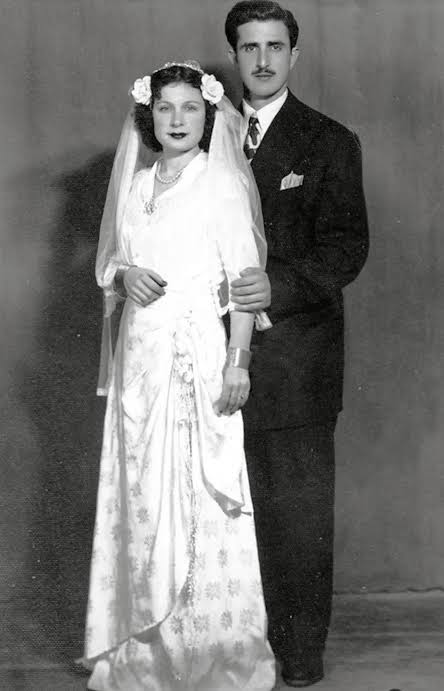
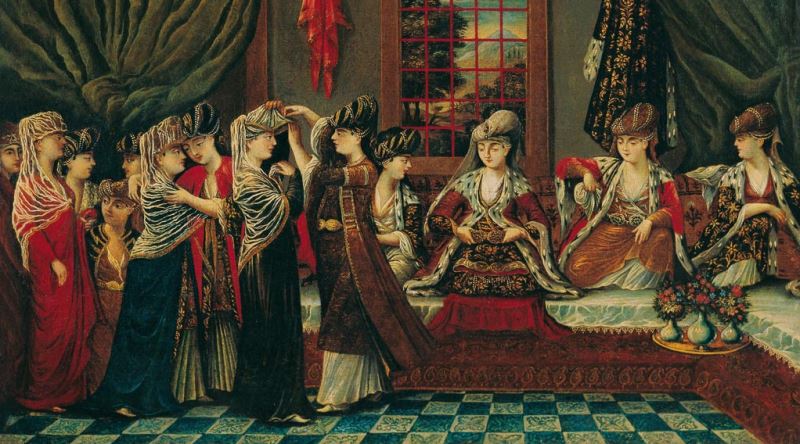
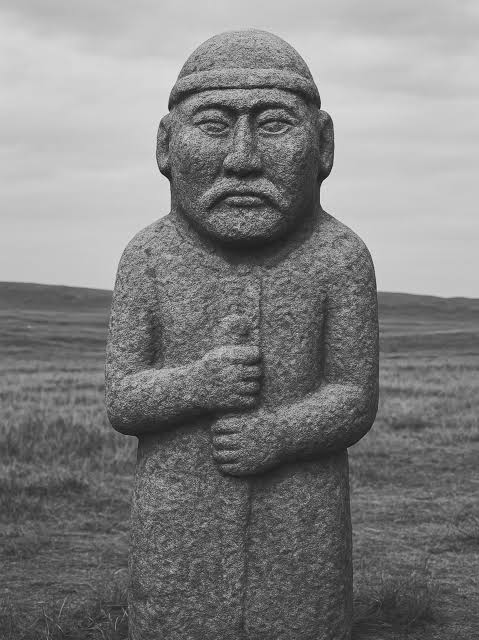
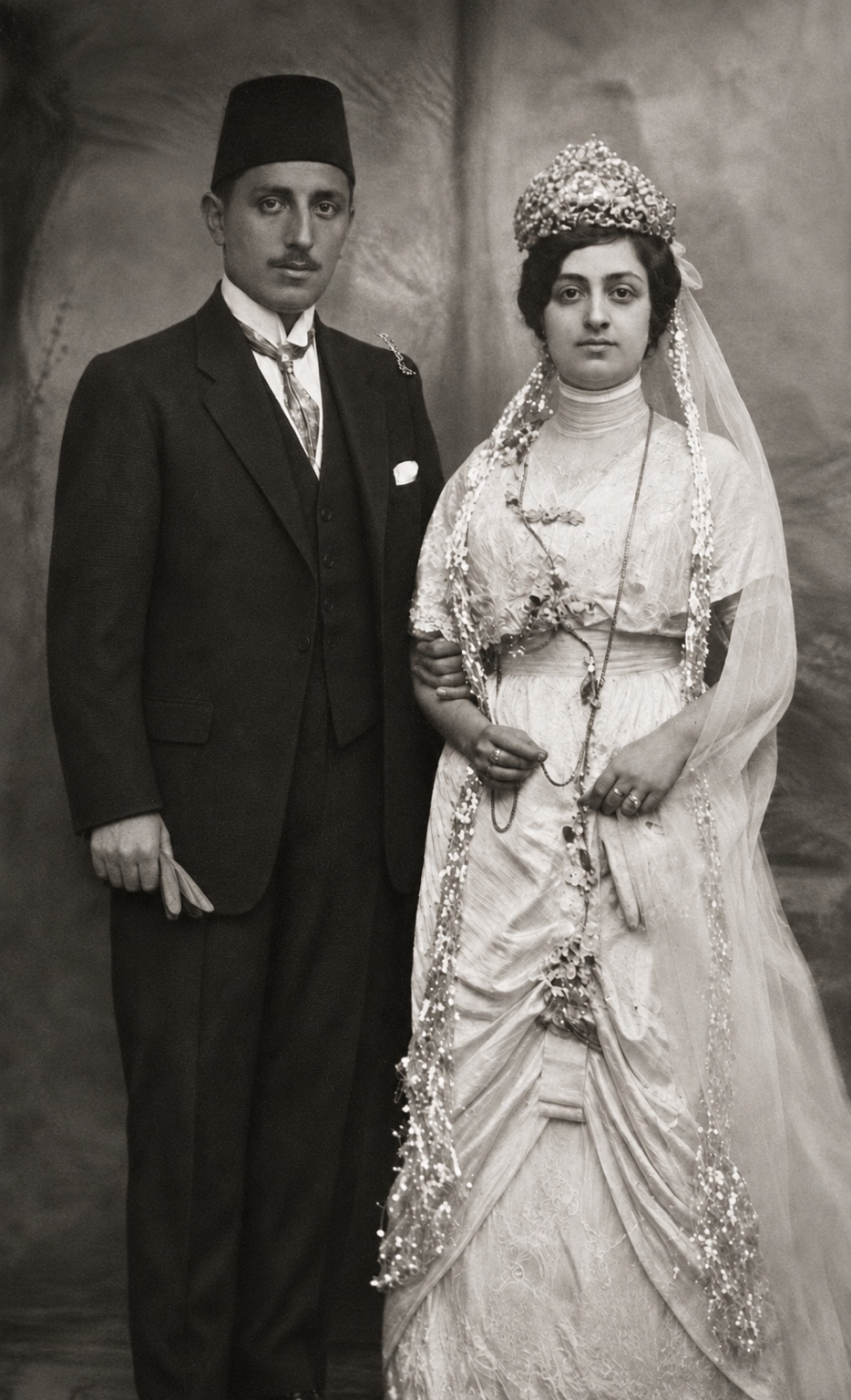
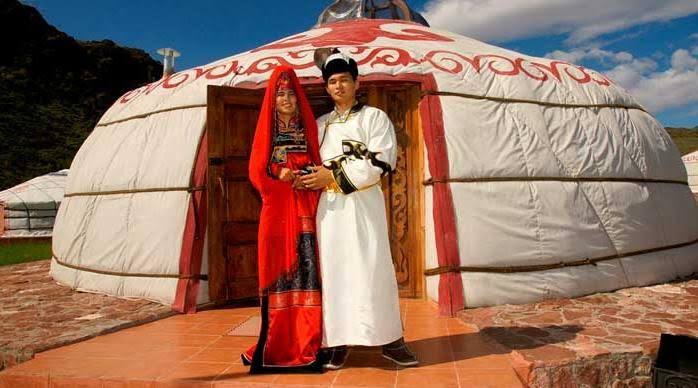
The photographs accompanying this story belong to later worlds than the early societies discussed here. Their couples stand still for the camera, giving us clothes, posture and the carefully arranged appearance of an occasion. They cannot tell us who negotiated the marriage, how the bride felt about leaving, or what the guests ate. A wedding portrait is a wonderful record of a moment, with most of the wedding just outside the frame.
Later Anatolian customs offer a closer view of the work surrounding that moment. Invitations could be carried by an okuyucu and accompanied by small symbolic gifts, known as okuntu. The trousseau might be displayed; a henna gathering brought women together before the bride’s departure. The sequence varied by locality. So did the balance of music, religious observance, family obligation and sheer enjoyment. 6
Among Tahtacı Alevi-Türkmen communities, ethnographic accounts describe another telling ceremony: ocak ayırma, the establishment of a separate household. Relatives and neighbours accompany the move, gifts help equip the home, and fire from the parental hearth may be used to kindle the new one. In some recorded versions, tea or coffee is prepared over that first fire and shared by those present. The youngest son’s household is treated differently, continuing the parental hearth. 7
It is a good place to leave this long history: a new fire, and people staying for a drink. The marriage has changed where someone lives. The neighbours have helped carry the things, the family has acknowledged the separation, and a household has begun with company.
Reading & context
- Early marriage customs and the limits of generalisation
Chinese dynastic histories: a comparative study in Tarih Araştırmaları Dergisi (2015) - Kalın and marriage transfers
Türk Dünyası Ansiklopedisi: Kalın - Weddings, public feasts and royal ceremony
Türk Kültüründe Eğlence ve Birlik Unsuru Olarak Düğünler (2009) - A distinct contemporary Kazakh wedding ritual
UNESCO: Betashar, traditional wedding ritual—2024 inscription - Offerings, hearths and regional interpretations
A study of transition rituals and beliefs in northwestern Ankara (2023) - Later Anatolian and Ottoman wedding customs
TDV İslâm Ansiklopedisi: Düğün - Establishing a household among Tahtacı communities
Tahtacılar’da Bir Göç Töreni: Ocak Ayırma (2011)