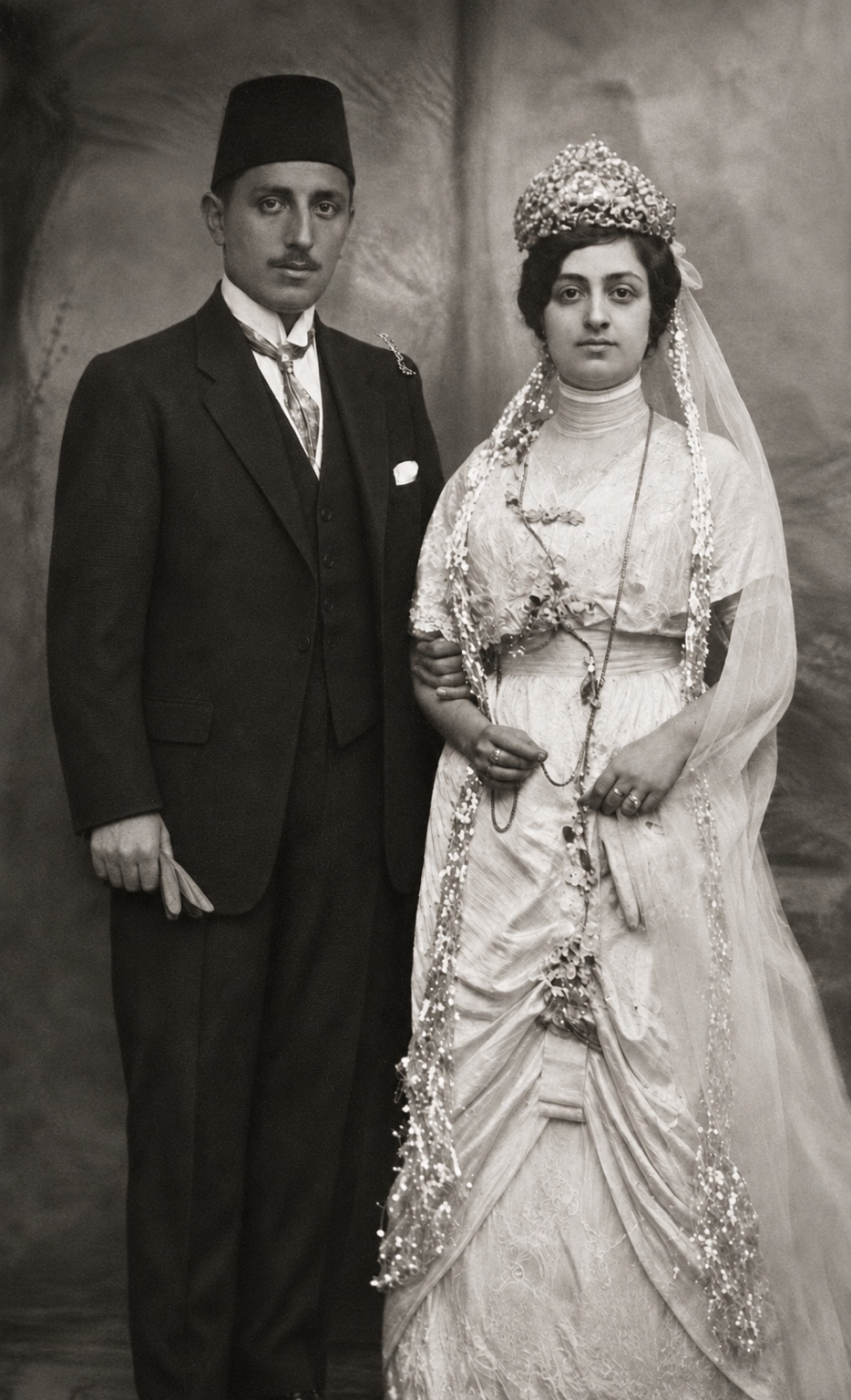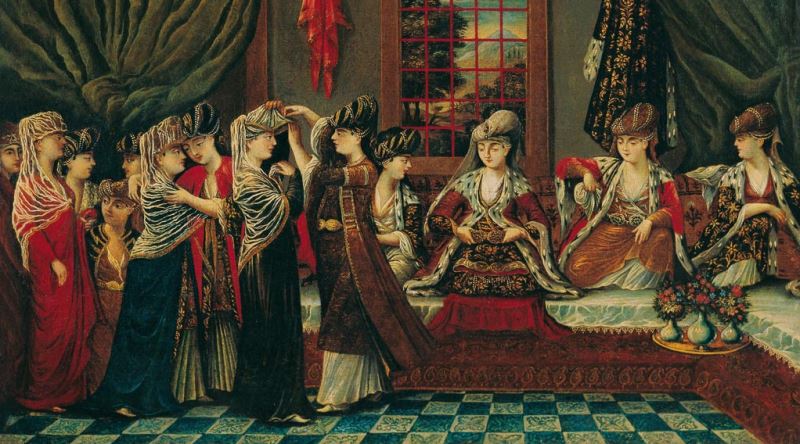
The label “Ottoman wedding” can do a great deal of work. A military band, whirling dervishes, a palace backdrop: put them on the same programme and the evening acquires an imperial atmosphere. Whether it resembles a historical wedding is another question.
For the families arranging one, there were rather more practical matters to consider. A marriage agreement had to be settled. A trousseau needed preparing and moving. Relatives expected to be invited, fed and given something to discuss afterwards. The bride had several ceremonies to get through before she reached her new home.
The details changed across the empire’s long history and its different communities. What follows looks mainly at Muslim wedding customs associated with Istanbul and Anatolia, alongside examples from the nineteenth-century administrative record. A palace celebration and a neighbourhood wedding could share customs while operating on very different budgets.
First, a word about the soundtrack
Mehter music did belong to Ottoman ceremonial life, including grand court festivities. Accounts of imperial celebrations describe military ensembles alongside other musicians, performers and processions. Removing the mehter from Ottoman history altogether would be just as misleading as placing one at every household wedding. 1
The whirling of the Mevlevi sema belongs to a distinct devotional tradition, with its own musical order, training and religious meaning. UNESCO’s account specifically notes how performances adapted for tourism have sometimes been shortened and detached from that setting. Hiring semazens for a reception does not, by itself, reconstruct an Ottoman marriage ceremony. 2
A modern couple can choose a theatrical theme. The historical claim simply needs more care than the decoration. Once that distinction is made, the less stage-ready parts of an Ottoman wedding become considerably more interesting.
The marriage had paperwork
In families using the görücü system, female relatives and intermediaries helped identify a prospective bride and arrange the first approaches. The resulting conversations concerned households as much as individuals: suitability, reputation, means and what each side would contribute. Agreement between the families set further preparations in motion.
The nikâh was the marriage contract; the düğün was the celebration surrounding it. Their timing did not have to coincide. Ottoman practice included permission from a kadı, the judge, for a marriage to be concluded, often by an authorised imam. Compliance was uneven, and recording and supervision became more insistent in the empire’s later years. A study of Antalya’s 1918–19 registers shows why the details mattered: identities, witnesses, representatives and agreed conditions could become evidence in a later dispute. 3
Mehir was a financial entitlement owed to the wife. Some might be paid promptly, with another portion deferred; in relevant circumstances, divorce or death made the outstanding amount due. In legal principle, it belonged to her. It was distinct from a payment to her family and from the çeyiz, the trousseau she brought into the household. Keeping those terms separate makes it easier to see whose money was being discussed. 4
A written obligation could give a woman grounds for a claim. It could not promise that every marriage would be equitable, or that collecting what was owed would be easy. The court record is useful precisely because it shows where family arrangements encountered disagreement.
A wedding took several days
Older accounts of Turkish wedding customs often describe a sequence that will still sound familiar: the trousseau prepared and displayed, a bridal bath on Tuesday, henna on Wednesday evening, and the bride’s departure for her new home on Thursday. This is a recognisable pattern, with local variations, rather than an itinerary followed by every Ottoman household. The contract might already have been concluded before any of these festivities began. 1
The çeyiz had both a domestic and a public life. Before its contents were used in the new home, they could be laid out for visitors to see. Moving them to the groom’s household made the coming marriage visible. A family’s preparation, needlework and expenditure were suddenly available for inspection. Wedding guests have never needed much encouragement to notice details.
The gelin hamamı had preparations of its own. Accounts describe a bathhouse hired for the occasion, or the guests’ admission paid for, with women from both families invited. Refreshments, music and the work of the bath attendants made it a social gathering as well as a bath. The bride might be ceremonially led through the space, washed, and brought back to the assembled women. Some versions included henna and the scattering of coins. 5
Women organised and occupied much of this part of the wedding. That gave them an important social space, although it could also place the bride under close scrutiny. Reducing the whole occasion to a mother-in-law inspecting a prospective daughter-in-law misses the company, hospitality and ceremony that made the bath an event worth arranging.
At the henna gathering, celebration made room for departure. The bride was preparing to leave the household in which she had grown up; the songs could acknowledge that loss even while everyone was wishing her well. The gold placed in a bride’s palm in some traditions, the henna itself and the women surrounding her each belonged to a carefully organised goodbye.
The street became part of the occasion
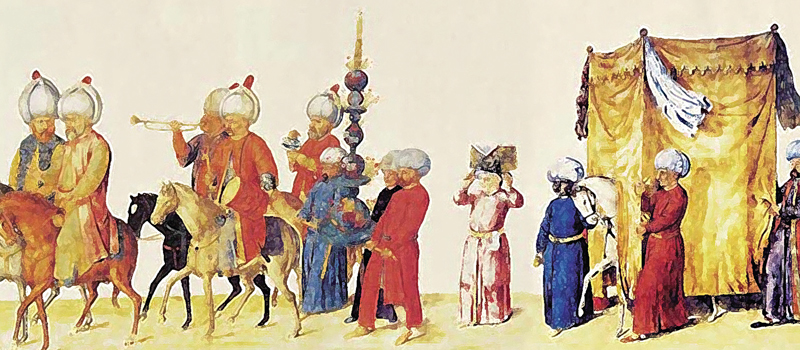
The journey between the two homes brought the wedding into public view. An announcement, a procession, the movement of possessions and the arrival of guests carried news beyond the immediate family. Even an event with separate gatherings for women and men could involve much of the surrounding neighbourhood.
For elaborate celebrations, there was the nahıl: a constructed, decorated tree carried in the procession. Wax ornament, artificial fruit and other embellishments could turn it into a conspicuous display of the host’s resources. Its scale varied enormously. The largest court examples created a practical problem: they had to fit through the streets. 6
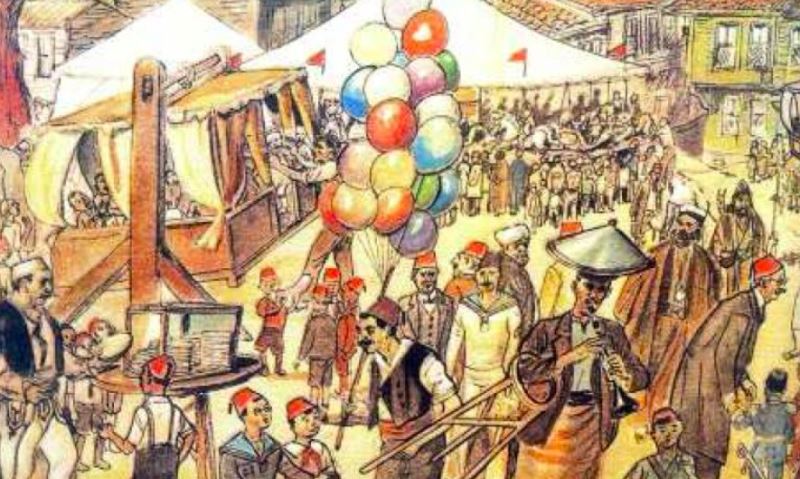
Accounts of exceptional imperial festivities describe projecting balconies and eaves being removed to clear a route, with rebuilding or compensation afterwards. It is a wonderfully specific measure of courtly excess: the decoration had become too large for the city. It is also a reminder that the magnificent procession in an illustration tells us little about what an ordinary household could afford. 6
At household level, the essential undertaking was hospitality. Rice, stuffed dishes and sweets appear in accounts of wedding preparations; the menu and quantities depended on place and means. Food might be made at home or bought in. Either way, someone had to calculate how much was enough. The ceremony joined two people, but the cooking was for considerably more.
The authorities also had a guest list of concerns
Extravagance worried officials as well as families. An 1874 decree classified those marrying into four groups and prescribed wedding expenditure and mehir amounts. How thoroughly these limits were enforced remains uncertain. The existence of a rule tells us what the authorities wanted; it does not give us the final bill. 4
Other interventions addressed immediate dangers. Nineteenth-century orders prohibited celebratory shooting, extending restrictions from loaded firearms to blank firing after that, too, caused deaths. The warnings had to be repeated. The familiar defence that something was customary did very little for the people standing nearby. 7
Overcrowded houses presented another risk. A report from Hısn-ı Mansur, today’s Adıyaman, recorded a fatal collapse during a wedding gathering in 1893. The response called for houses intended for such events to be inspected by municipal building specialists, with a report confirming their ability to bear the crowd before permission was given. The archive brings the occasion down to its physical requirements: a celebration needed a building capable of holding its guests. 7
These documents preserve failures and official responses, so they cannot tell us how every party unfolded. They do show the range of people drawn into arranging one: relatives, cooks, musicians, religious and judicial officials—and, when necessary, someone who understood the floor beams.
After the procession
The bride’s arrival brought one stage of the wedding to a close. It also brought the work of preparation to its destination: possessions in another house, promises made public, two families newly connected. The tears at departure and the expectation of a feast could belong to the same occasion without cancelling each other out.
An Ottoman wedding is easier to understand when attention moves between the contract, the women at the bath, the people carrying the trousseau and the kitchen feeding the guests. The band may be the part a modern event remembers first. Someone still had to organise dinner.
Reading & context
- Wedding sequences and the different scale of court festivities
TDV İslâm Ansiklopedisi: Düğün - The devotional context of sema
UNESCO: Mevlevi Sema ceremony - Late Ottoman marriage registration
Antalya’da Evlilik ve Boşanma (1918–1919), Genel Türk Tarihi Araştırmaları Dergisi - Mehir and attempts to regulate expenditure
TDV İslâm Ansiklopedisi: Mehir - The bridal bath as a social occasion
TDV İslâm Ansiklopedisi: Hamam - Processional ornaments and court display
TDV İslâm Ansiklopedisi: Nahil - Nineteenth-century safety orders and building inspections
Düğünlerde Yaşanan Olumsuzluklara Karşı Osmanlı Devleti’nin Almaya Çalıştığı Tedbirler (2017)