At the entrance to an Anatolian ruin, the language often arrives before the stones. Greek city. Roman theatre. Byzantine church. Seljuk caravanserai. Ottoman bridge. Each label is useful; each can also behave like a border drawn backwards through time. The visitor is invited to admire a succession of civilisations, but rarely to ask how those civilisations became separate possessions in the first place.
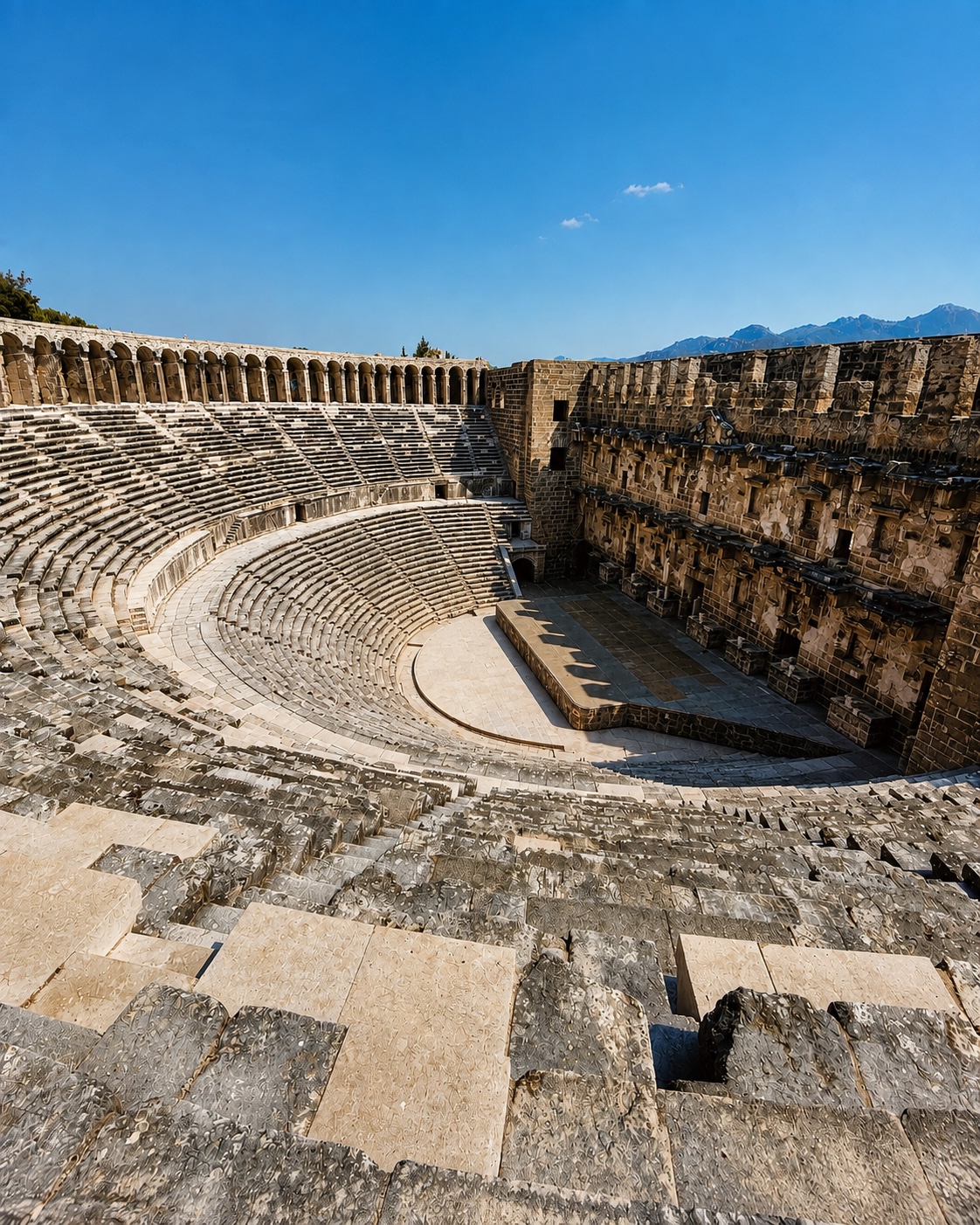
The question returns whenever the ground opens. In July 2026, archaeologists at Aspendos brought a roughly 300-metre Roman-period main street back into view, together with houses, public buildings, a monumental gate and drainage infrastructure. Weeks earlier, a mosaic of the local river god Young Eurymedon had emerged near Theatre Street. In 2025, a marble Hermes and fragments associated with Aphrodite, Eros, Artemis and Nemesis were recovered from the same city.
The discovery may be Roman. The ground is Anatolian. The responsibility is contemporary.
A label can clarify—and quietly claim
Calling a theatre Roman is not the same as granting modern Italy its title deed. “Greek”, “Roman” and “Byzantine” are scholarly descriptions of period, language, political power and visual culture. Without them, history becomes vague. Yet in museums, guidebooks and tourism copy, classification can slip into possession. “Greek ruins in Turkey” makes modern Türkiye sound like an accidental address: a storage site for a history imagined elsewhere.
Aspendos refuses that neatness. Its theatre is Roman in form, its city has Pamphylian roots, its water system belongs to a local landscape and its stones have lived through Seljuk repair, modern archaeology, opera audiences and the daily economy of Antalya. None of those layers cancels another. A monument can have several inheritances without becoming ownerless.
Sardis and the problem of the single shelf
Sardis makes the argument sharper. The capital of Lydia also carries Persian, Hellenistic, Roman, Byzantine, Ottoman and Republican histories. A colossal column from its Temple of Artemis entered the Metropolitan Museum of Art in 1926 through the American excavation society. The Met catalogues it under “Greek”; the object’s own description nevertheless acknowledges a local design tradition. Both statements can be true. The trouble begins when the first travels farther than the second.
Early foreign excavations expanded knowledge, trained scholars and saved material that might otherwise have been lost. They also worked within unequal legal and political systems that allowed parts of Anatolia to be distributed through Western collections. “Universal access” cannot be invoked as though this history were frictionless. Nor can restitution be reduced to a contest between modern flags.
Türkiye is not the only heir
The nationalist answer—that every object found within today’s borders belongs culturally and exclusively to the modern nation—is no more convincing. The people who made a Lydian vessel, prayed before Artemis or laid a Roman mosaic did not anticipate the Republic of Türkiye. Greeks, Armenians, Kurds, Jews, Syriacs, Italians, archaeologists, nearby villagers and diasporic communities may all recognise parts of their history in the same place.
Shared inheritance is not diluted inheritance. It simply refuses the fantasy that one present-day identity can retroactively absorb every life that passed through Anatolia.
Anatolia’s past is not a trophy to be nationalised. Türkiye is not a neutral warehouse for somebody else’s civilisation either.
Ownership is the least interesting test
Türkiye’s cultural-property law places archaeological material under state protection. That answers who is legally responsible. It does not finish the ethical work. Stewardship must also mean conservation after the press photographs, publication that scholars can examine, interpretation in Turkish and other relevant languages, meaningful local participation, physical access and an honest account of how objects left the country.
The better question is therefore not “Whose antiquity is this?” but “Who protects it, who gives it context, who is allowed to speak through it—and who can still encounter it without buying a plane ticket to New York?”
A mature relationship with Anatolia’s past would neither provincialise it as exclusively Turkish nor export it conceptually as exclusively Greek, Roman or Byzantine. It would let the site remain what the peninsula itself has always been: specific, layered, contested and impossible to fit inside a single modern border.